
What Happens If You Ignore a Missing Tooth? The Long-Term Effects on Your Oral Health
A missing tooth is often judged by where it sits. A front tooth is treated as urgent because it shows. A missing molar may be ignored for years because nobody can see it in a photograph. Clinically, that distinction is not very useful. The mouth responds to function, loading and contact, not to whether the gap is socially noticeable.
Once a tooth is lost, the neighbouring teeth can begin to tilt or drift. The opposing tooth may move further into the empty space because it has lost its normal contact. Food may pack into areas that were previously easier to clean. A bite that felt balanced can gradually become less predictable. The American Dental Association notes that a missing molar can affect chewing, that remaining teeth may shift, and that bone loss can occur around a missing tooth.
None of this happens at the same speed in every patient. A person may leave a lower first molar missing for five years and appear to cope reasonably well. Someone else may develop marked tooth movement and a difficult bite much sooner. Age, gum health, the tooth that was lost, clenching habits and the condition of the rest of the dentition all matter.
This is why Missing Tooth Replacement in Kochi should begin with diagnosis rather than a discussion about which artificial tooth looks best.
What happens to the jawbone after a tooth is lost
Bone is not simply a fixed block holding the teeth. After extraction, the local ridge remodels and can become narrower and lower with time. For an implant patient, the practical consequence is straightforward: a site that might once have accepted an implant relatively simply may later require more planning, and occasionally bone augmentation.
Patients sometimes misunderstand this and assume that once the gum has “healed”, everything underneath has returned to normal. The gum can look perfectly calm while the ridge beneath it has changed.
Some also postpone replacement because the extracted tooth caused pain or infection and they simply want a break from dentistry. Quite understandable. Yet “I will replace it later” can turn into three or four years.
Implants have a genuine advantage in selected cases because they can replace a tooth without preparing healthy neighbouring teeth, and hospital guidance recognises their role in preserving jaw bone. But an implant is not biologically invulnerable. Implant tissues can become inflamed, bone can be lost around an implant, and excessive loading or poor integration can contribute to failure.
That nuance matters when discussing Dental Implants in Kochi. The useful question is not, “Are implants the best?” It is, “Is an implant the best option in this mouth?”
Chewing, speech and facial appearance are connected to the missing tooth
People adapt remarkably well. That is both helpful and misleading.
Lose a tooth on one side and it is common to start chewing more on the other side without consciously deciding to do so. For a while, this may cause little trouble. It becomes less sensible when the preferred side contains heavily restored teeth, gum disease, a tender jaw joint or another missing tooth. A replacement should restore useful function, not merely fill a photograph. Missing teeth can interfere with chewing, particularly when posterior teeth are involved.
Speech is more relevant when front teeth are missing because airflow and tongue contact change. Replacing the tooth may improve certain sounds, although speech does not automatically normalise overnight. Patients who have lived with a gap for years may have developed compensatory habits. Leeds Teaching Hospitals notes that implant replacement aims to improve chewing, speech, appearance and comfort.
Facial change is more complicated than advertisements suggest. A single missing back tooth does not suddenly “collapse the face”. Larger areas of tooth loss, loss of vertical support and substantial bone and soft-tissue change can alter facial support over time.
Aesthetic planning also deserves restraint. Smile Makeover in kochi should not become a reason to over-treat healthy teeth. Sometimes the gap is the main problem. Sometimes it sits within a broader issue involving tooth position, colour, worn edges, gum levels or the bite. Smile Designing in kochi is most useful when it helps visualise those relationships before irreversible treatment. Kalarickal Dental Care describes digital smile designing as part of its approach to planning smile rehabilitation and missing-tooth treatment.
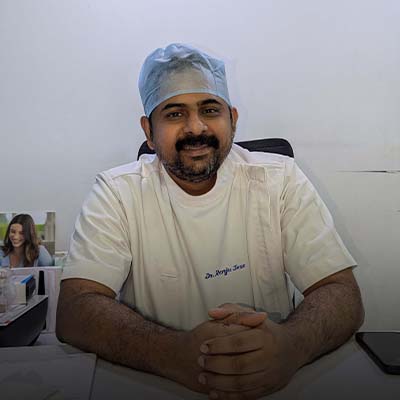
Losing a tooth affects more than the appearance of your smile. It can influence chewing, neighbouring teeth, and the overall balance of your bite. Prof. Dr. Renju Jose has over 20 years of dental experience, with expertise in Oral Implantology, Endodontics, Orofacial Pain, and TMD.
At Kalarickal Dental Care in Panampilly Nagar, Kochi, he assesses each patient's oral condition to determine suitable options for replacing missing teeth and restoring comfortable dental function. A consultation with an experienced dentist can help you understand the consequences of leaving a missing tooth untreated and explore appropriate replacement options.
Implants, bridges and dentures: the choice is less obvious than it sounds
For a single missing tooth, three broad routes usually enter the discussion: an implant-supported crown, a tooth-supported bridge, or a removable partial denture. These are established approaches, but they solve the same problem in quite different ways.
A bridge can be an excellent restoration. The NHS describes a bridge as a fixed replacement supported by surrounding teeth. The claim that bridges are outdated is too simplistic. If the adjacent teeth already need crowns, using them to support a bridge may be entirely sensible. If both adjacent teeth are pristine, cutting them down purely to support a bridge is a more serious biological trade-off.
An implant avoids preparing neighbouring teeth and can feel very natural once restored. Yet implant treatment may be unsuitable or need modification when bone volume is poor, gum disease is uncontrolled, oral hygiene is weak, smoking is heavy, systemic health complicates healing, or available space is unfavourable. It also needs long-term maintenance and professional review.
A removable denture is sometimes dismissed too quickly. For an older patient missing several teeth, particularly when surgery is not desired, a well-designed removable prosthesis may be the more proportionate treatment. It is removable and can feel bulkier. Those are disadvantages, but they do not make it a poor treatment by definition. The NHS lists dentures, bridges and implants as recognised approaches for replacing missing teeth.
Good Missing Tooth Replacement in Kochi is not the most expensive option placed into every patient. It is the restoration that gives acceptable function, cleans well, respects the remaining teeth and has a maintenance burden the patient can realistically manage.
Timing matters, but rushing can be as unhelpful as waiting
Early assessment is sensible. Immediate treatment is not always sensible.
After an extraction, the site may need time to heal. If infection was present, the tissues may need reassessment. An implant can sometimes be placed immediately, but treatment suitability depends on the amount and quality of bone, gum condition, remaining teeth, general health and local anatomy.
The mistake is assuming that “early replacement” means choosing a procedure before the reason for tooth loss has been understood. If a tooth was lost because of advanced gum disease, putting an implant into a mouth where active periodontal disease remains untreated is poor sequencing. Periodontal disease damages the tissues and bone supporting teeth and can ultimately lead to tooth loss. If the tooth fractured because of severe grinding, the bite and loading need attention. If decay destroyed it because of dry mouth or repeated sugar exposure, replacing the tooth without addressing the cause simply transfers risk elsewhere. Persistent dry mouth itself raises the risk of tooth decay.
Replacement also needs space. Teeth that have drifted may leave too little room for a correctly shaped crown. The opposing tooth may have over-erupted. Orthodontic movement or restorative correction may sometimes be needed before the final replacement. A “simple implant” may no longer be simple.
For that reason, assessment for Missing Tooth Replacement in Kochi should look beyond the empty socket. Radiographs, gum condition, bite, available space, neighbouring restorations, bone anatomy, medical history and the patient’s tolerance for surgery all influence the plan.
Kalarickal Dental Care in Panampilly Nagar lists dental implant treatment, restorative care and digital smile rehabilitation among its services. Prof. Dr. Renju Jose is listed by the clinic as a specialist in oral implantology as well as endodontics and orofacial pain.
FAQ
1. What happens to your teeth and jawbone when a missing tooth is left untreated?
Adjacent teeth may drift or tilt, the opposing tooth may move into the gap, chewing can change and bone in the area can reduce with time. The degree varies considerably. A stable-looking gap is not proof that nothing is changing.
2. What are the best treatment options for replacing a missing tooth?
Usually an implant-supported crown, a fixed bridge or a removable denture. For several missing teeth, implants can also support bridges or stabilise some dentures. The best choice depends on bone, gums, neighbouring teeth, bite, medical history, hygiene and cost.
3. Why is early tooth replacement important for long-term oral health?
Early assessment may catch a site before drifting, over-eruption or ridge change complicates treatment. Early does not mean hurried. Sometimes the correct decision is to monitor healing before proceeding.
4. Why choose Kalarickal Dental Care for Missing Tooth Replacement in Kochi?
The clinic lists implant treatment, digital dentistry and smile rehabilitation among its services, with dedicated implantology expertise. It also states that it uses implant systems including Straumann, Zimmer and Bredent. Brand matters less than case selection, placement, restoration and follow-up.
5. Can I live with a missing tooth if it isn't visible?
Possibly. Not every gap must be replaced. A dentist may sometimes advise accepting a space when function is adequate and replacement offers little benefit. The decision should follow an examination of the bite and remaining teeth, not visibility alone.
6. Is a dental implant always the best option for replacing a missing tooth?
No. Poor bone, active gum disease, difficult anatomy, medical factors or limited ability to maintain an implant may shift the balance towards a bridge, denture or no replacement. Implant suitability depends on several patient and site-specific factors.
7. Can replacing a missing tooth improve my speech?
Yes, particularly when front teeth are involved. The improvement depends on which tooth is missing, how long it has been absent and whether compensatory speech habits have developed. Restoring missing teeth can improve speech as well as chewing and comfort.
8. Can missing teeth affect facial appearance?
They can, especially when several teeth are absent or there has been substantial loss of bone and dental support. The effect of one missing molar is usually far less dramatic than cosmetic advertising implies.
9. How do I know which tooth replacement option is right for me?
The decision comes from the whole mouth, not the gap. Bone volume, gum stability, neighbouring teeth, bite forces, available space, medical factors, cleaning ability, expected longevity and budget all matter. Implant treatment in particular depends on bone, gum condition, remaining teeth and general health.
10. How soon after an extraction can a missing tooth be replaced?
Sometimes immediately, sometimes after weeks or months of healing. Infection, bone condition, gum tissue, tooth position and the planned restoration all affect timing. In difficult sites, a staged approach may be slower but more predictable.
Visit Your Trusted Dentist in Panampilly Nagar, Kochi
Choosing the right dental professional ensures long-term oral health, comfort, and personalized care. At Prof. Dr. Renju Jose’s clinic, patients receive expert treatment using advanced technology and a patient-centered approach. Whether you need routine preventive care or specialized treatments, you’re in trusted hands.
Contact Address
Kalarickal Dental Care
28/93A, Main Avenue, near DDRC SRL corporate office, Manorama Junction, Panampilly Nagar, Kochi Kerala 682036
090203 03031


Locate Us

© 2026 Kalarickal Dental Care. All rights reserved.
© 2026 Kalarickal Dental Care.
All rights reserved.